
1. Introduction
Choosing open-pollinated seeds is not only a gardening decision — it is a decision about nutrition, biodiversity and soil health. Organic and open-pollinated (OP) seeds support living soils, flavor, dietary diversity and low-input gardening systems.
This guide explains why choosing organic & OP seeds matters for gardeners, cooks and food enthusiasts — in simple, neutral and science-based terms.
2. Nutrition & Dietary Diversity
Crop diversity directly shapes dietary diversity. Organic, heirloom, landrace and farmer-bred seeds preserve:
✔ micronutrients
✔ phytonutrients
✔ flavor & aroma
✔ nutritional variability
Institutions such as the FAO highlight crop diversity as a pillar of food security, nutritional resilience and wellness.
3. Biodiversity & Pollinated seeds
OP seeds reproduce through natural pollination networks, supporting:
✔ genetic diversity
✔ pollinators & beneficial insects
✔ local adaptation
✔ ecosystem function
Biodiversity is functional — not cosmetic.
4. Soil Health & Low-Input Gardening
Organic seeds are cultivated without synthetic pesticides, fungicides or fertilizers, supporting:
✔ soil microbiome integrity
✔ nutrient cycling
✔ humus formation
✔ root-microbe interactions
This approach aligns with soil ecology work from INRAE and low-input agriculture research.
5. Reproducibility & Seed-Saving
Unlike hybrids, organic OP seeds are:
✔ true-to-type
✔ reproducible
✔ seed-saving compatible
Seed-saving strengthens:
✔ genetic continuity
✔ nutritional diversity
✔ flavor & culture
✔ resilient food systems
Food autonomy today does not mean withdrawing from the system; it means contributing to biodiversity, dietary quality, resilient and sustainable food cultures.
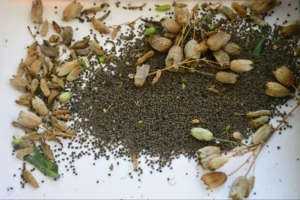
6. F1 & GMO — Why Not for Home Gardens
F1 hybrids and GMOs serve industrial priorities such as:
✔ uniformity
✔ logistics
✔ mechanization
But not:
✖ seed-saving
✖ biodiversity
✖ flavor
✖ nutrition
Reproducibility:
- F1 hybrids are not reproducible (F2 segregation)
- GMOs are non-reproducible for farmers due to patents & legal restrictions
Both are not organic-certified and not intended for home gardening.
7. Why SeedsWild Curates Organic & OP Seeds
SeedsWild selects seeds that are:
🌱 organic or organically grown
🌱 open-pollinated & reproducible
🌱 GMO-free & patent-free
🌾 biodiversity-friendly
🐝 pollinator-supportive
🧬 microbiome-respectful
🌍 low-input compatible
🚫 no synthetic pesticides
🚫 no fungicides
🚫 no synthetic fertilizers
8. Summary — Who Benefits?
Organic & OP seeds are relevant for:
✔ home gardeners
✔ balcony growers
✔ food & flavor lovers
✔ chefs & culinary creatives
✔ biodiversity gardeners
✔ wellness-driven eaters
✔ climate-conscious growers
9. FAQ
- Are organic seeds better for nutrition?
They preserve diversity, linked to micronutrients & phytonutrients. - Can I save seeds from F1 hybrids?
Not reliably — they don’t reproduce true-to-type. - Are GMO seeds for home gardening?
No — they are industrial & not organic-compatible. - Are heirloom and OP seeds the same?
All heirlooms are OP, not all OP are heirlooms.
🛒 10. Growing for diversity & wellness
🌱 Growing for diversity & Wellness
Gardening is becoming more than plant care — it is becoming a form of intention.
Choosing organic & open-pollinated seeds means choosing nutrition, biodiversity, flavor and resilience, all within a low-input and soil-friendly approach.
If this perspective resonates with how you want to garden, here are the seeds that align with it:
→ Shop Organic & Reproducible Seeds
→ Seeds for Nutrition & Flavor
→ Seeds for Biodiversity & Pollinators
And if you want to go further by learning, planning and connecting:
→ Annual Planting Guide for 2026
→ Plan Your Garden with SeedsWild AI
→ Join the Biodiversity Gardening Community