
More and more gardeners are turning away from industrial seed catalogues and looking for open-pollinated, reproducible varieties they can trust. Interest in buying non-hybrid seeds has grown steadily as awareness of food autonomy, biodiversity, and organic growing practices spreads across France and beyond. Yet the seed market remains confusing: labels overlap, marketing language can mislead, and not every packet that looks “natural” actually is. This guide explains what non-hybrid seeds really are, why they matter, and how to choose and buy them with confidence, including where SeedsWild fits into the picture.
Où trouver et comment reconnaître de vraies semences non hybrides F1 (non-hybrid seeds) ?
Temps de lecture : ~7 min
- What are non-hybrid, open-pollinated seeds?
- Why buy non-hybrid seeds rather than F1 hybrids
- Non-hybrid vs hybrid F1 seeds
- How to buy non-hybrid seeds online with confidence
- SeedsWild, a marketplace built for organic and open-pollinated seeds
- Steps to take action
- FAQ
- Why non-hybrid seeds are worth choosing

What are non-hybrid, open-pollinated seeds?
A non-hybrid seed comes from a plant that was pollinated naturally, without controlled crossing between two selected parent lines. The key property is that it is reproducible: if you grow the plant and harvest its seeds at maturity, the next generation will be similar to the mother plant. This is why these seeds are often called open-pollinated or reproductible in French-language contexts, and why they are associated with heirloom and traditional varieties.
Hybrid F1 seeds work differently. They are produced by deliberately crossing two genetically distinct parent lines to obtain a first-generation plant with specific traits such as uniformity, yield, and disease resistance. The resulting seeds do not reliably reproduce those traits in the next generation, which means gardeners must buy new seeds every season. This is not a defect in the technical sense, but it does create a structural dependency on seed companies and gradually erodes the diversity of cultivated varieties.
Key terms to know before buying
| Term | Meaning |
|---|---|
| Open-pollinated or reproducible | Seeds that breed true to type over generations. |
| Heirloom or “variété ancienne” | An open-pollinated variety with a documented history, often selected over decades or centuries for flavour, resilience, or local adaptation. |
| Organic (bio) | Seeds produced from mother plants grown under certified organic conditions, without synthetic inputs, for at least one full growing season (two seasons for perennials). |
| Non-treated | Seeds not coated with any fungicide, insecticide, or other chemical coating before packaging. |
| Non-GMO | Seeds not genetically modified in a laboratory. In France, GMO seeds are already prohibited for field crops, but the label reassures gardeners about the full supply chain. |
| Free-of-rights or “libres de droit” | Seeds that carry no plant variety protection restricting your right to save, share, or resow them. |
These categories can overlap but are not identical. A seed can be non-hybrid without being certified organic, or organic without being free-of-rights. For most home gardeners and permaculture practitioners, the ideal combination is open-pollinated, organic, non-treated, non-GMO, and free-of-rights.
Why buy non-hybrid seeds rather than F1 hybrids
A long-term investment in autonomy
Choosing open-pollinated organic seeds is often described as investing once in a high-quality product and then multiplying your own seeds from year to year. Over several seasons, this approach reduces purchasing costs significantly and builds genuine food autonomy. With F1 hybrids, that cycle is broken by design.
Biodiversity and soil health
Non-hybrid varieties, especially heirlooms, preserve a wider genetic pool. Growing them supports biodiversity at the plot level and contributes to conserving older, less standardised varieties that have adapted to specific soils and climates over generations. Organic seeds, produced without synthetic inputs, also support richer microbial life in the soil around the roots, which benefits plant health over time.
Flavour and health
Organic non-hybrid seeds help limit chemical residues in the vegetables and fruits you harvest. Many gardeners and food enthusiasts report that heirloom varieties, selected historically for taste rather than shelf life or transport resistance, offer richer and more complex flavours than their hybrid counterparts.
Ethical and legal freedom
Seeds that are free-of-rights can be saved, shared, and resown without legal restriction. This is the principle defended by organisations like Kokopelli, which sells only organic, free-of-rights, reproducible seeds. It reflects a broader movement for seed sovereignty: the idea that seeds are a commons, not a corporate asset.
Non-hybrid vs hybrid F1 seeds
| Criterion | Non-hybrid (open-pollinated) | Hybrid F1 |
|---|---|---|
| Reproducibility | Yes, breeds true to type | No, offspring varies |
| Cost over time | Decreasing (save your own seeds) | Recurring annual purchase |
| Variety diversity | High, many heirloom options | Limited, standardised traits |
| Local adaptation | Improves over generations | Fixed at breeding stage |
| Autonomy | High | Low |
| Typical yield | Variable, often excellent for flavour | Often high, uniform |
It is worth noting that F1 hybrids are not inherently bad: professional growers sometimes choose them for specific disease resistance or yield consistency. But for a home gardener, a permaculture enthusiast, or anyone building food autonomy, open-pollinated seeds are the more sustainable and empowering choice.

How to buy non-hybrid seeds online with confidence
The online seed market has expanded rapidly, and with it, the risk of greenwashing. A packet with a hand-drawn illustration and the word “natural” on the label does not guarantee anything. Here is what to look for before completing a purchase.
Check the key labels and claims
Look for explicit mentions of “non-hybrid”, “open-pollinated”, or “reproductible”. If the seed is also organic, it should carry a recognised certification (AB in France, or an equivalent European standard). “Non-treated” and “non-GMO” should be stated clearly. If a seller cannot or does not specify these details, that is a reason to look elsewhere.
Read the product page carefully
A trustworthy seller will provide the sowing period, expected germination rate, seed count per packet, and basic cultivation advice. This information signals that the seeds have been properly tested and that the seller knows their catalogue.
Verify the seller’s sourcing and values
Some vendors are also producers, which gives them direct control over growing conditions and seed quality. Others source from a network of small organic farms. Either can be reliable, but transparency matters. Associations like Kokopelli or producers like La Ferme de Sainte Marthe have built their reputation on clear commitments to organic, reproducible, free-of-rights seeds.
Check delivery terms and return policies
For perishable or time-sensitive products like seeds, knowing the shipping delay, packaging quality, and return conditions is part of the purchase decision. Reputable online shops state these clearly in their terms and conditions.
SeedsWild, a marketplace built for organic and open-pollinated seeds
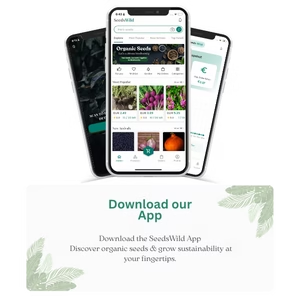
SeedsWild is designed specifically for gardeners who want to buy non-hybrid seeds from verified, trustworthy sellers. Rather than a single-brand catalogue, it operates as a marketplace where independent sellers, including small organic producers, offer their ranges alongside each other. This means you can compare varieties, read detailed product descriptions, and find seeds adapted to your specific growing context, all in one place.
The platform also includes a recommendation tool powered by the SeedsWild AI, which helps you identify the most suitable varieties for your soil type, climate, and gardening objectives. Whether you are looking for heirloom tomatoes, old-variety flowers to support pollinators, or aromatic herbs for a balcony, the recommendation engine narrows down the options based on your actual situation rather than offering a generic catalogue.
Explore the current selection directly on the SeedsWild shop, or use the recommendation tool to get personalised suggestions. You can also add seeds to your wishlist and compare varieties side by side using the compare feature.
A few examples of open-pollinated varieties currently available on SeedsWild include the Pomponette Daisy Mixed, the Lupin Annual Mixed, and the Red Amaranth, a vigorous and visually striking plant that also attracts beneficial insects.

Steps to take action
Buying non-hybrid seeds for the first time does not require a complete overhaul of your garden. A practical approach is to start small and build progressively.
Define your priorities
Are you focused on self-sufficiency, flavour, biodiversity, or all three? This will guide your variety choices.
Start with easy species for seed saving
Tomatoes, beans, and peas are self-pollinating and straightforward to save. They are a good entry point for anyone new to the practice.
Buy from a verified source
Use a marketplace or shop that clearly states whether seeds are non-hybrid, organic, non-treated, and non-GMO. Check the product page for germination rate and sowing guidance.
Plan your seed saving from the start
Choose one or two plants per variety to let go to seed. Harvest at full maturity, dry thoroughly, and store in a cool, dark, dry place in paper envelopes or glass jars.
Connect with local networks
Seed swaps, organic markets, and gardening associations are excellent places to exchange varieties, get advice, and discover locally adapted seeds that may not appear in any online catalogue.
FAQ
Are all non-hybrid seeds organic?
No. A seed can be open-pollinated and reproducible without being certified organic. The two qualities are independent. For the most complete approach, look for seeds that are both non-hybrid and organic: this means the mother plant was grown without synthetic inputs and the seeds themselves have not been treated with any chemical coating.
Can I save seeds from any non-hybrid plant?
In principle, yes. However, some species cross-pollinate easily with neighbouring plants of the same family, which can alter the offspring. Courgettes, squash, and brassicas, for example, require some distance or isolation between varieties to maintain seed purity. Self-pollinating species like tomatoes, beans, and peas are much simpler to work with and are recommended for beginners.
Are non-hybrid seeds less productive than F1 hybrids?
Not necessarily. F1 hybrids are often bred for high and uniform yield, which can make them look more productive on paper. But many heirloom and open-pollinated varieties perform excellently in well-managed organic soil, and they often outperform hybrids on flavour, resilience over time, and adaptability to local conditions. The comparison depends heavily on the variety, the growing context, and what you value most in a harvest.
Why non-hybrid seeds are worth choosing
Choosing to buy non-hybrid seeds is both a practical gardening decision and a small act of ecological commitment. It means investing in varieties that can be saved, shared, and improved over time, rather than purchasing the same standardised packet every spring. It supports biodiversity, reduces dependence on industrial supply chains, and often results in better-tasting food. SeedsWild was built to make that choice easier, by bringing together verified organic and open-pollinated seeds in one transparent marketplace. If you are ready to explore what is available, the SeedsWild shop is the right place to start.