
Looking for a free gardening app (application jardinage gratuite) in 2026 means sorting through dozens of listings that all claim to be free, while many of them lock the most useful tools behind a paywall. Some are free to download only, others offer a genuine free tier, and a few are entirely free with no in-app purchases at all.
This comparison looks at what each option really gives you without paying, from botanical photo identification to sowing calendars and garden journals. We also explain where SeedsWild AI fits for gardeners who grow organically and want their app connected to real seeds. Prices and features were checked in September 2026 and should be verified in your app store before downloading.
Best Application Jardinage Gratuite (Free Gardening App) in 2026 – Honest Comparison
Reading time: ~10 min
- What “free” actually means in a gardening app
- Free gardening apps compared
- The best free plant identification app
- Free plant care apps and watering reminders
- Free vegetable garden planners and sowing calendars
- Offline use, in-app purchases and data privacy
- Where SeedsWild AI fits for the organic gardener
- Choosing without regret
- Frequently asked questions
What “free” actually means in a gardening app
Before comparing features, it helps to separate four very different business models that all appear under the same search. A free download simply means no upfront payment, and it says nothing about what you can do once the app is installed. A free tier is a version you can keep using indefinitely, usually with caps on the number of plants tracked, scans performed or reminders created.
A completely free app has no premium subscription and no in-app purchases. Finally, a time limited free trial gives you full access for a few days before automatic billing starts, which is the model most likely to disappoint someone looking for a gardening app without subscription.
This distinction matters because the most polished interfaces tend to belong to freemium products. Comparison sites report that Planta sits around 7.99 dollars per month or 35.99 dollars per year for its premium plan, that PictureThis is commonly listed near 39.99 dollars per year after a seven day trial, and that Gardenize Plus is quoted around 44.99 dollars per year. Greg funds its SUPER plans through in-app purchases reported between 1.99 and 39.99 dollars depending on the plan, while the Garden+ premium unlock appears at 3.99 dollars on its App Store listing. None of those numbers make an app bad, but they do change the answer to the question you are really asking.
Free gardening apps compared (applications de jardinage gratuites)
The table below summarises what the main options give you inside their free tier, what they are genuinely good at, and where the limits appear. It covers both indoor vs garden plants use cases, since an app built for houseplant care rarely handles a vegetable garden plan well.

| App | Free tier | Best for | Paid option checked September 2026 | Main limit |
|---|---|---|---|---|
| PlantNet | Fully free, community funded | Botanical photo identification of wild and native species | None reported | Almost no care tracking or watering reminders |
| Greg | Generous free tier | Plant tracking, watering advice, gardener community | SUPER plans via in-app purchases, 1.99 to 39.99 dollars | Advanced features reserved for SUPER |
| Vera | Free | Simple watering reminders for beginners | None reported | No species recognition, no disease diagnosis |
| From Seed to Spoon | Limited free tier | Vegetable garden planning, planting calendar, crop tracking | Premium unlock | Capped plant tracking and assistant questions |
| Garden+ | Free with optional unlock | Offline digital garden journal and data privacy | 3.99 dollars premium | Extra photos and notes are premium |
| Planta | Limited free version | Polished care routines and light measurement | 7.99 dollars per month or 35.99 dollars per year | Key tools behind the premium subscription |
| Gardenize | Free version | Garden areas, photos and task journalling | Plus plan near 44.99 dollars per year | Advanced organisation is paid |
| PictureThis | Free download or trial | Photo identification with a species database of over 400,000 entries | Around 39.99 dollars per year after a 7 day trial | Unlimited scans and diagnosis are paid |
The best free plant identification app
If your main need is a free plant identification app, PlantNet remains the reference. It was built as a scientific and community project, it works by uploading a photograph, and every submission feeds a shared species database rather than a commercial funnel. For anyone identifying hedgerow flowers, meadow species or volunteer seedlings, that community approach usually beats a commercial engine, and the absence of advertising is a real comfort. In France, gardeners who want to go further often cross check results with the francophone botanical network Tela Botanica before recording a species.
PictureThis is the other name you will see everywhere as a plant identification by photo app. Its species recognition is fast and it adds disease screening, but the free download quickly runs into scan limits, and its paid plan around 39.99 dollars a year after a seven day trial makes it a freemium product rather than a free one. As a rule, use a botanical tool for wild plants and a commercial engine for ornamental varieties, and treat any artificial intelligence result as a strong hypothesis rather than a certainty.
Good to know
A photo identification result depends heavily on what is in the frame. Photographing the leaf, the flower and the whole habit separately improves accuracy far more than upgrading to a premium subscription.
Free plant care apps and watering reminders
Notification tools vs advisory tools
For watering, the useful distinction is between a notification tool and an advisory tool. Vera is the simplest free plant care app in this group, with a clean interface and watering reminders that beginners can set up in minutes. Greg goes further by combining species recognition, plant tracking and watering recommendations calibrated by a large gardener community, which makes it one of the more convincing free options for indoor collections. Planta produces the most refined care routines, including light measurement, but its free version is deliberately narrow and most of what makes the app attractive belongs to the paid plan.
These tools share one blind spot. They are designed for potted plants in a stable indoor environment, so they rarely account for rainfall, soil type or exposure. A free plant watering app is helpful for a balcony collection, and much less reliable for an open vegetable bed where the weather does most of the watering.
Free vegetable garden planners and sowing calendars
Vegetable garden apps need different features
Gardeners who grow food need different features, and this is where most plant care apps stop being relevant. What matters here is a vegetable garden plan, a sowing calendar, realistic harvest dates, crop rotation over several seasons, companion planting suggestions and frost alerts tied to your climate zone. From Seed to Spoon is the clearest candidate among mainstream apps, with a free tier that covers basic planning and premium features that unlock broader crop tracking and a complete planting calendar. The Old Farmer’s Almanac remains a solid free sowing calendar app companion for localised advice, with an optional paid tier for an ad free experience.

One practical warning applies to every free vegetable garden planner. Most planting calendars are built on United States hardiness zones, which describe winter cold rather than summer heat or rainfall patterns. A French gardener in Brittany and another in Provence can share a USDA zone and still need sowing dates several weeks apart, so always adjust calendar suggestions to local observation.
Offline use, in-app purchases and data privacy
An offline gardening app matters more than people expect, because gardens and allotments often sit outside mobile coverage. Garden+ is the main option built around offline functionality, and its App Store listing states that personal data stays on the phone and that the app does not collect data. That is a publisher declaration rather than an independent audit, so it should be read as such, but it is still a rare position in this market.
Data privacy deserves a moment of attention. Gardening apps commonly request camera access, location, usage analytics, account details and device information. Under the General Data Protection Regulation, publishers operating in Europe must tell you what they collect and why, and the App Privacy section on the Apple App Store and the data safety section on the Google Play Store are the fastest way to check before installing. Free apps with no visible in-app purchases have to be funded somehow, and understanding how is part of choosing well.
Important
A plant disease diagnosis feature, free or paid, is an aid and not a verdict. Cross check any diagnosis with visual guides or a local gardener before acting, especially when the suggested treatment involves removing plants.
Where SeedsWild AI fits for the organic gardener
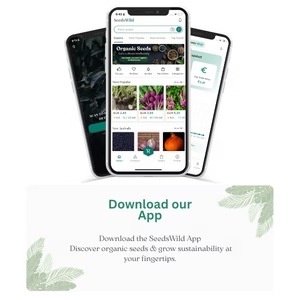
Most of the apps above solve one problem well. Identification tools recognise species, care apps send watering reminders, planners generate calendars, and journals store notes. What they rarely do is connect your plan to the seeds that actually suit your garden. That gap is exactly why we built SeedsWild AI as artificial intelligence applied to gardening rather than to houseplant maintenance alone.

Our approach combines personalised seed recommendations based on your space, climate and experience level, real time weather alerts including frost warnings, and guidance you can consult season after season as a digital garden journal.
Because the assistant sits alongside the Seeds Wild marketplace, a recommendation can lead directly to organic and reproducible seed varieties instead of a generic shopping list. It also fits our editorial library, from our permaculture and sustainable gardening guide to our seasonal calendar, so a beginner gardening app user is never left with an alert and no explanation.
For an eco gardener, that integration is the deciding factor. A free gardening app that identifies a plant is useful. An app that recommends what to sow, warns you before the frost, records what worked and points you to seeds grown without chemical inputs answers the whole question. On iPhone and Android, the practical test is the same for every option in this comparison. Install two apps at most, one for identification and one for planning, and keep the one you still open in October.
Choosing without regret
The honest conclusion is that no single app wins every category. PlantNet is the strongest free identification tool, Vera and Greg cover watering with no upfront cost, From Seed to Spoon handles vegetable planning, Garden+ protects offline use and privacy, and Planta, Gardenize and PictureThis deliver polish in exchange for a subscription. If your gardening is centred on growing food organically, choosing seeds well and following the rhythm of the seasons, SeedsWild AI is the option designed for that specific journey, and it costs you nothing to test before deciding.
FAQ
Does a free gardening app need my location to work?
Most planning and weather features do, because frost alerts and sowing dates depend on where you garden. Identification and journal tools usually work without it, and you can often grant location access only while using the app.
Can I use several gardening apps together without duplicating work?
Yes, and many experienced gardeners do. A common setup is one identification tool, one planning tool and one journal, with the journal acting as the single record of what was sown and harvested.
Are free versions enough for a balcony garden?
For a small collection of containers, a free tier is usually sufficient, since caps on tracked plants rarely become a problem below twenty pots. Larger vegetable plots hit those limits faster.
What should I check before deleting a gardening app?
Export or screenshot your notes and photos first. Several journals store data locally, which means uninstalling the app removes several seasons of observations permanently.
Do app subscriptions renew automatically after a trial?
Usually yes. A time limited free trial normally converts into a paid plan unless it is cancelled in your Apple or Google account settings before the trial ends.